
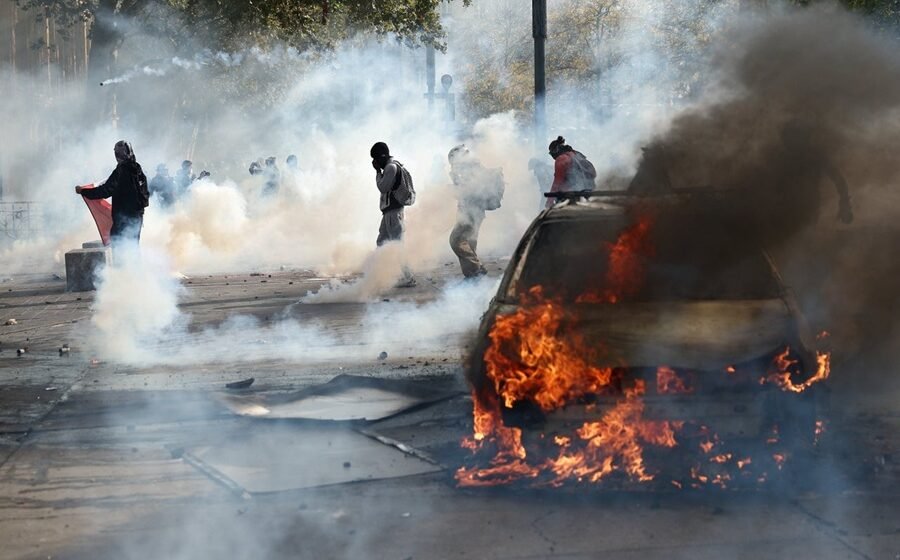

France riots flared for a second day on Sunday, 18 October 2026, as looting resumed around Place de la République in Paris, less than 24 hours after nationwide cost of living protests turned violent. More than 1,800 people have been arrested, according to The Independent.
Presidential candidate Marine Le Pen used the moment to warn of a “threat to democracy” and to attack President Emmanuel Macron, shortly before his televised address due at 8 pm local time. The unrest matters beyond the clean-up. It is landing months before the 2027 presidential election, and every camp is already using it to argue about who can restore order.
France Riots Today: What Happened
Saturday’s marches were called over rising living costs. France’s Interior Ministry said around 550,000 people took part, while the CGT union put the figure at 800,000, The Independent reported. Many marchers were peaceful, but violent groups set fires, attacked police vehicles and broke into shops and supermarkets.
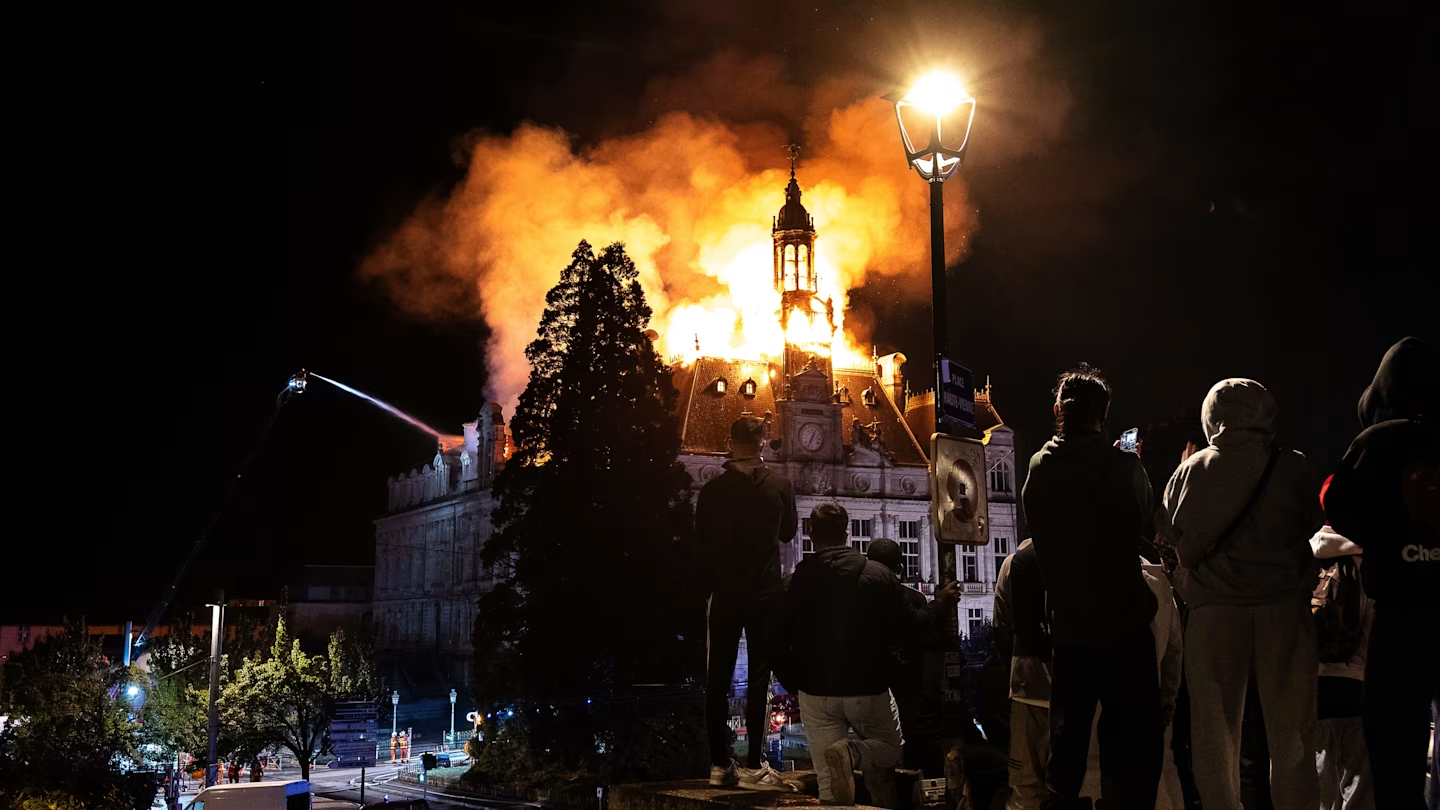
The first trouble came early. Black-clad protesters stormed the city halls in Paris and Marseille before official marches began. In Lyon, the tourism office was set on fire. In Limoges, a listed town hall that opened in 1883 was largely destroyed after its roof collapsed. Local prefect Maurice Barate called it a “heritage catastrophe”.
Limoges mayor Guillaume Guerin, who is centre-right, said no national police officer was left to guard the building because forces had been sent to the street protests. Paris recorded 855 arrests, a record, and one protester died after a cardiac arrest. Officials say more than 500 police officers and firefighters were injured nationwide.
On Sunday, Euronews reported that the CRS-8 riot unit was deployed for a second day. Several hundred rioters clashed with police near Place de la République. The Paris police prefecture said an undeclared call to gather there at 14:00 had spread on social media.
Marine Le Pen’s Reaction: “Crisis of Confidence”
Speaking less than two hours before the Macron address, Marine Le Pen said France is facing a “crisis of confidence”, according to Euronews. She blamed the far left and Macron, whom she described as lacking credibility and authority.
Jordan Bardella, president of the National Rally, spoke after visiting a Paris police station. He said order “no longer exists” in France and that the country was “humiliated” on Saturday night.
The government has a different framing. Interior Minister Laurent Nuñez wrote that the right to protest is fundamental but organised disorder is not. Prime Minister Sébastien Lecornu blamed “orchestrated violence” by ultra-left groups and warned against using the unrest as a “warm-up” for the presidential election. Both sides point at the far left, but they disagree on who failed to prevent the violence.
Why It Happened: Cost of Living and a Student Revolt
- The movement began last month at high schools in poor northern suburbs of Paris, over teacher absences and failing facilities, The Independent reported.
- Anger grew over perceived police brutality against student protesters, according to wire reports.
- Purchasing power has fallen since 2024, and fuel prices have jumped since the US-Iran war began earlier this year, wire reports say.
- Officials say radical far-left groups drove part of the violence and that others joined later to loot.
The mix explains why the cost of living protests escalated so fast. A narrow school grievance became a national complaint about inequality and public spending. That gave violent fringes a large, crowded stage.
Background: Why France Keeps Seeing Street Unrest
Street protest is a normal part of French politics, and the presidency is powerful enough to attract most of the blame. Earlier crises followed a similar pattern. The Yellow Vest movement began in 2018 over fuel taxes, and the 2023 riots followed the police shooting of a teenager at a traffic stop. Both mixed economic anger with distrust of the authorities.
The Limoges mayor’s complaint adds another layer. When national police are pulled into the largest marches, local buildings can be left exposed. That question will likely return in any review of how the France riots were handled.
Other Cities and Wider Impact
- Paris: Damage was reported at Les Halles, the Opera and stores including Nike, Sephora and Burger King. The monument at République was covered in graffiti.
- Marseille: Shops including Hermès were vandalised, and clean-up crews worked on Rue Saint-Ferréol. The city opened an information point for affected businesses.
- Lille and Nice: Lille’s Socialist mayor said looters broke into an Apple Store. Sportswear shops and a motorbike dealership were hit in Nice.
- Europe: Smaller cost of living protests took place in Belgium, Portugal and Italy over the weekend.
Euronews also reported that the Bouches-du-Rhône prefecture counted more than 30,000 looters in Marseille on Saturday. That figure looks very large next to the national arrest total and has not been confirmed elsewhere, so treat it with caution.
What Comes Next
- Macron’s address: It is due at 8 pm local time, after an emergency meeting with top officials. What he will announce is not yet known.
- Mayors’ meeting: The mayors of Paris, Marseille and Lyon asked to meet the prime minister in the coming days.
- Prosecutions: Macron has vowed to punish those who attacked businesses and buildings. With more than 1,800 arrests, court cases are likely to follow.
- More gatherings: Sunday’s undeclared call shows how quickly crowds can form. Whether further protests are planned is not yet known.
What Readers in France Should Do
- Avoid Place de la République and shopping districts in large cities while clashes continue.
- Follow the Paris police prefecture and your local prefecture for official notices.
- Check transport and shop opening times before travelling, as clean-up work is under way.
- Foreign visitors should check their own government’s travel advice and keep a distance from police lines and tear gas.
- Affected businesses in Marseille can use the city’s information point.
The Bigger Picture
The France riots show how quickly an economic complaint can turn into a dispute over order and legitimacy. Macron cannot seek a third term, but how his government handles this crisis will shape the 2027 race. The National Rally, with Marine Le Pen and Jordan Bardella leading the message, frames the violence as proof that the state has lost control. The government frames it as the work of a violent far-left fringe. Both claim to defend peaceful protest, yet the images of burnt buildings risk drowning out the original grievances about prices and schools. The Macron address will show whether the response leans on security, economic relief, or both.
This is a developing story and will be updated.
Sources