

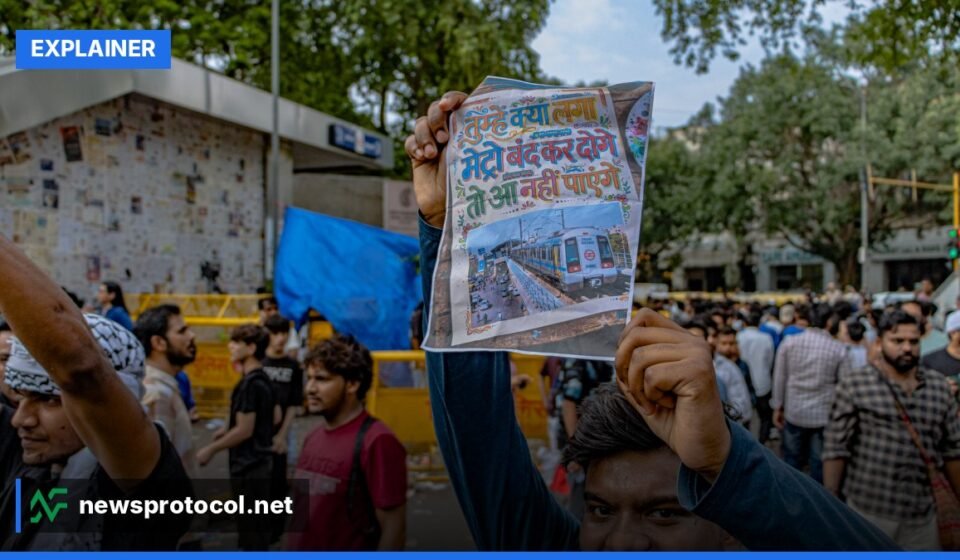

France protest reasons come down to conditions in the country’s schools: missing teachers, classes of 32 to 36 pupils, run-down buildings, stress over the Parcoursup admissions system and a budget that trims billions from public spending.
The unrest began with high school blockades in the Paris suburbs in September 2026. It has since pulled in teachers, parents, trade unions and left-wing parties, and it runs alongside a separate public-sector strike over the 2027 budget.
What follows is a guide to each grievance, the numbers behind it, and how the French government has answered.
Key Facts
- The protest movement is dated from September 18, 2026 by Wikipedia’s timeline, starting at Lycée Saint-Exupéry in Créteil, outside Paris, over teacher shortages and scarce resources.
- More than 250,000 people joined the largest day of demonstrations in over a dozen cities, including about 56,000 in Paris, according to the French Interior Ministry.
- Prime Minister Sébastien Lecornu said 215 students and 85 school staff members were injured; a national police spokesperson told RTL radio that more than 600 officers were hurt.
- Al Jazeera reported the government budget contains €54 billion ($61.3 billion) of funding cuts and savings, while Wikipedia’s summary cites €61 billion in new spending cuts.
- Arrest tallies conflict: the Justice Ministry reported more than 6,000 arrests, 87% of them minors, while Justice Minister Gérald Darmanin put the figure at 2,700 as of October 22, 2026, according to Wikipedia.
Why are students protesting in France?
Students are protesting because they say French high schools do not have enough teachers, desks, nurses, supervisors or usable buildings. The first blockades began at Lycée Saint-Exupéry in Créteil, southeast of Paris, in late September 2026, according to TIME, and spread through the Île-de-France region before reaching the rest of the country.
The education ministry told Al Jazeera that protests had touched about 400 of France’s 3,700 lycées, the schools that take pupils aged 15 to 18. By the end of that week, the interior ministry counted more than 500 disrupted schools, TIME reported.
Pupils describe similar conditions in different cities. One 15-year-old in the Paris suburb of Pantin told Reuters his class had 35 students and not enough chairs. A 17-year-old in Strasbourg told AFP the cafeteria was too small and the building was falling apart.
What are the main France protest reasons?
The France protest reasons overlap, and they differ by school. Education Minister Édouard Geffray said that variation is part of the problem.
“One of the difficulties of this movement is that there are no national demands. It all started with local demands,”
Édouard Geffray, French Education Minister, TIME
Teacher shortages and unfilled posts
The education ministry found that nearly 10% of teaching hours went untaught in public secondary schools during the 2024-2025 school year, and about 7.5% of those lost hours came from a failure to find substitutes. Ryad Rani, president of the Union Syndicale Lycéenne, told Al Jazeera about a pupil who went seven months without a French teacher in a year with a French exam.
Overcrowded classrooms and run-down buildings
Class sizes of 32 to 36 pupils are routine, according to Rani. A 17-year-old at Lycée Paul-Éluard in Saint-Denis described temporary toilets without water, rats and cockroaches, and temporary classrooms swinging from −5 °C in winter to 40 °C in summer. The Créteil education authority told AFP that demands also included more education assistants, nurses, social workers and managers.
Heatwaves and school infrastructure
Summer heat exposed how poorly French schools are built for high temperatures. Vincent Latour, a professor of British studies at Université Toulouse Jean Jaurès, told Al Jazeera the discontent had been building since June.
“There has been discontent since successive heatwaves in June this year, which revealed the poor state of schools, with poor insulation and no air conditioning,”
Vincent Latour, Université Toulouse Jean Jaurès, Al Jazeera
TIME reported that nearly 8,000 people died in France over the summer as a result of high temperatures, and Wikipedia notes classroom temperatures reaching 40 °C (104 °F) during the 2026 European heatwaves.
Parcoursup and exam stress
Pupils also object to Parcoursup, the national online platform for university applications. France Info summarised the demands it heard from pupils as more resources, smaller classes, better buildings, enough staff and less stress from Parcoursup.
Budget cuts and the cost of living
The school protests coincide with a public-sector strike against the government’s budget plans. Al Jazeera reported the plan includes €54 billion ($61.3 billion) in cuts and savings, and that the government proposes freezing state employees’ base salaries in 2027 to save about €2 billion ($2.27 billion). Unions say that would be the fourth consecutive annual freeze.
France protest reasons in numbers
The figures below come from French ministries, unions and reporters on the ground, and they do not always match because they were recorded at different points in the movement.
| Reason or indicator | Figure and source |
|---|---|
| Unfilled teaching hours, public secondary schools, 2024-2025 | Nearly 10% (Education Ministry, via TIME) |
| Class sizes reported by pupils | 32 to 36 pupils (Ryad Rani, Union Syndicale Lycéenne, Al Jazeera) |
| Cuts and savings in the budget plan | €54 billion / $61.3 billion (Al Jazeera); €61 billion (Wikipedia) |
| Proposed 2027 pay freeze for state employees | About €2 billion ($2.27 billion) in savings (Al Jazeera) |
| Schools disrupted at the peak | More than 500 (Interior Ministry, via TIME) |
| Arrests | More than 6,000, 87% minors (Justice Ministry, via TIME); 2,700 as of October 22, 2026 (Gérald Darmanin, via Wikipedia) |
Where did the French student protests spread?
The protests spread from the Paris region to most of France within about two weeks. Reuters tracking cited by TIME placed demonstrations in Rennes, Nantes, Quimper and Brest in the west; Bordeaux, Toulouse, Toulon, Marseille and Grenoble in the south; Strasbourg in the east; and Lille in the north.
Police counted roughly 900 demonstrations on a single day during the escalation, according to TIME. Clashes broke out in Strasbourg, Lyon, Rennes and Paris, where demonstrators set fires and threw projectiles and officers fired tear gas.
Violence also produced serious injuries. In Lens, in the Pas-de-Calais department, a 15-year-old boy lost his hand and part of his lower arm after picking up a stun grenade thrown by police during a demonstration, according to La Voix du Nord and François-Xavier Lauch, the prefect of Pas-de-Calais.
How do the school protests connect to the budget fight?
Teachers and pupils say they are protesting the same thing from different sides of the classroom door. Caroline Cheve, secretary-general of the FSU education union federation, told Al Jazeera that pupils and staff face identical conditions.
“They’re in overcrowded classrooms,” she said, according to Al Jazeera. “Sometimes they don’t have enough teachers because of staffing shortages.”
The education ministry said just over 11% of teachers and other school staff joined the public-sector action, Al Jazeera reported. Trade unions across the public sector, including firefighters, took part in the same day of strikes.
Politics sits underneath all of it. Prime Minister Lecornu is trying to pass a 2027 budget through a divided parliament, and parties are positioning themselves for the presidential election in spring 2027. Jean-Luc Mélenchon, leader of La France Insoumise, accused the government of ordering a crackdown on high school students; Lecornu called that an “irresponsible escalation” and rejected Mélenchon’s claim of a racist undertone as “an insult.”
The wider political temperature shows in other disputes covered by News Protocol, including the government’s move to ban what it called illegitimate demonstrations and the curfews imposed in Paris, Lille and Nice. Businesses near the flashpoints have counted their own costs, detailed in our report on the curfew’s impact on shops and closures.
How has the French government responded to the protests?
The government has offered talks with students and school leaders, promised a national debate in schools, and rejected accusations of heavy-handed policing. Geffray said secondary schools would set aside a half-day “first with the staff, then with the students, for an in-depth, open, and democratic debate, everywhere.”
Interior Minister Laurent Nuñez told BFM TV that 440 people had been detained nationwide at an early stage of the unrest, about two-thirds of them placed in police custody. He said the police response had been proportionate in almost all cases and that some protests had turned into riots.
Human rights bodies disagree. Amnesty International denounced a “disproportionate” use of force, Human Rights Watch reported serious injuries to children, and the UN Human Rights Office called on all sides to keep protests peaceful and avoid disproportionate force, according to Wikipedia’s account of the unrest.
Security forces have also paid a price. A police officer was struck and killed by a vehicle in Nantes on October 17, 2026, and about 1,000 officers were injured that day, seven of them seriously, Wikipedia records.
FAQ
What started the France protests in 2026?
High school students at Lycée Saint-Exupéry in Créteil, outside Paris, blockaded their school in September 2026 over teacher shortages and scarce resources. Blockades spread across the Paris region and then nationwide, drawing in teachers, parents, unions and political parties.
What are the main reasons students are protesting in France?
Students cite unfilled teaching posts, classes of 32 to 36 pupils, dilapidated buildings, summer heat in classrooms without air conditioning, stress over the Parcoursup university admissions platform, and budget cuts that they say hit schools and public services.
How many people have been arrested during the French student protests?
Tallies differ. The Justice Ministry reported more than 6,000 arrests, 87% of them minors, according to TIME. Justice Minister Gérald Darmanin said 2,700 people had been arrested as of October 22, 2026, with 217 jailed after fast-track trials, according to Wikipedia.
Are the French protests only about schools?
No. The school blockades overlap with a public-sector strike against the 2027 budget, which Al Jazeera reported contains €54 billion ($61.3 billion) in cuts and savings. Protesters also raise fuel costs, rents, inflation and unemployment.
What has Emmanuel Macron’s government offered protesters?
The government promised talks with student and school representatives and a half-day of debate in secondary schools once classes resumed, announced by Education Minister Édouard Geffray. It has rejected claims of disproportionate police force while acknowledging some protests turned into riots.
Sources: TIME – Wikipedia – Al JazeeraUpdated: October 28, 2026.